
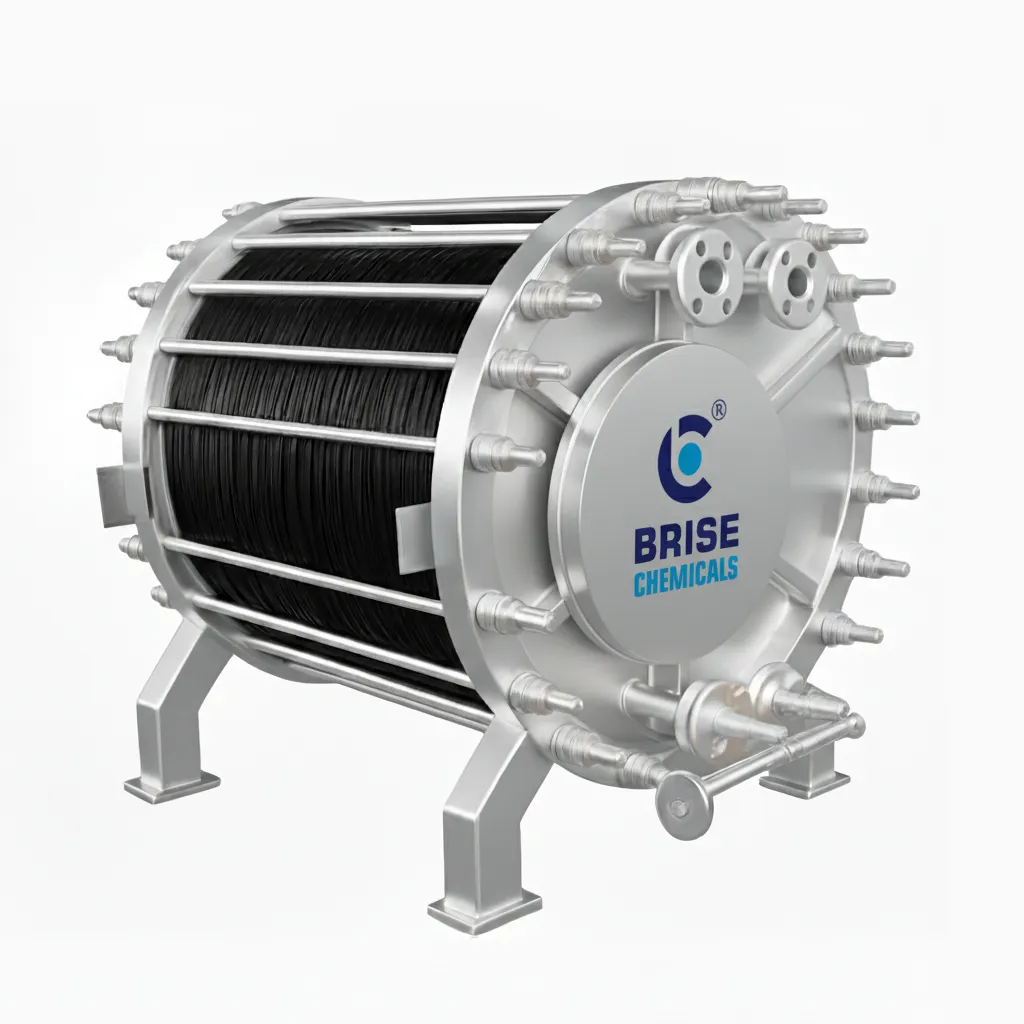
Alkaline Electrolyser
Technical Specification
| Category | Specification |
|---|---|
| Electrolyte | 30% NaOH / KOH |
| Stack Size (Energy Consumption) | 3.8 – 4.4 kWh/Nm³ |
| Operating Temperature | 70 – 90 °C |
| Operating Pressure | 1-30 barg |
| Ambient Temperature | 5 – 35 °C |
| Cell Voltage | 230 – 420 V |
| Current Density | 0.2 – 0.8 A/cm² |
| Stack Current | 100 – 4000 A |
| Cell Active Area | 125 – 20,000 cm² |
| Hydrogen Purity (H₂) | 99.99 – 99.9999% |
| Oxygen Purity (O₂) | 99.99 – 99.9999% |
| Oxygen Limit in H₂ | < 2 ppm v |
| Moisture Content | < 2 ppm v |
Brise Electrolyser Key Features
| Category | In-House Capability Focus | Key Expertise & Functions |
|---|---|---|
| I. Core Technology OEM (Electrolyzer Stack) | Product Design & Manufacturing Mastery |
|
| II. Balance of Plant (BOP) Integration | Process System Engineering & Safety |
|
| III. EPC Execution (Balance of System - BOS) | Project Construction & Field Installation |
|
| IV. Commissioning & O&M | Performance Guarantee & Asset Reliability |
|
Appliction
- Industrial hydrogen production
- Green hydrogen for fuel cells and mobility
- Steel, refinery and chemical industries
- Ammonia and methanol production
- Power generation & renewable energy storage
Process Description
Brise Chemicals offers high-efficiency bipolar alkaline hydrogen electrolyzers that split high-purity De- ionzed water into hydrogen and oxygen using DC power. In our compact bipolar design, hydrogen forms at the cathode and oxygen at the anode, delivering higher efficiency and reduced internal losses. The system operates at 0–30 bar, producing pressurized hydrogen without the need for a separate compressor.
The generated oxygen can be released or utilized, while hydrogen can be stored, compressed, or used in various clean- energy applications.
- Raw Water Pre-Treatment and Ultrapure Water Generation
To raw water undergoes a rigorous purification sequence to prevent impurities scaling and damaging diaphragm, the raw water treatment is carried out as below:
- Primary Filtration: Raw water is dosed with coagulants and passed through a Multi-Grade Sand Filter (MGF) to remove bulk suspended solids and turbidity.
- Ultrafiltration (UF): The water passes through hollow-fiber UF membranes, acting as a physical barrier against biological contaminants, algae and colloidal silica.
- Double-Pass Reverse Osmosis (RO): A high-pressure RO system forces the water through semi-permeable membranes, rejecting 98% to 99% of total dissolved solids & ionic loads.
- Electrodeionization (EDI) Polishing: The RO permeate enters the EDI module, which uses a direct electrical current to continuously regenerate specialized mixed-bed ion-exchange resins. This final polishing stage removes the remaining trace ions, delivering Ultrapure Water (UPW) with a conductivity strictly maintained below 1 µS/cm and Total Organic Carbon (TOC) below 30 ppb.
- Pressurized Bipolar Electrolysis
The DI water is fed into the electrolyte circulation loop, where it homogenized with 30% by weight aq. KOH solution. This electrolyte solution is pumped into two independent 1.25 MW bipolar cell stacks, each capable of producing up to 250 Nm3/h of hydrogen. The separator is a specialized composite diaphragm material. This material allows the free transfer of hydroxide ions while physically blocking the crossover of H2 and O2 gases. When the DC power is applied from the power (IGBT) rectifier, the following electrochemical reactions occur:
- Cathode (Reduction – Hydrogen Evolution Reaction): 2H2O(l) + 2e– → H2(g)+2OH–(aq)
- Anode (Oxidation – Oxygen Evolution Reaction): 2OH–(aq) → ½ O2(g) + H2O(l) + 2e–
- Overall, Cell Reaction: H2O(l)→ H2(g) + ½ O2(g)
To optimize performance under variable solar/ battery power profiles, the dual-redundant PLC system employs an equal distribution control strategy for the 1+1 stack configuration. This logic ensures that if available power drops below the minimum safe operating threshold of a single stack, one stack is safely placed into a hot-standby mode while the full available current is routed to another, thus maintaining operation in a highly efficient and safe current density range. As the gases evolve, they form a two-phase mixture alongside the hot KOH lye.

