
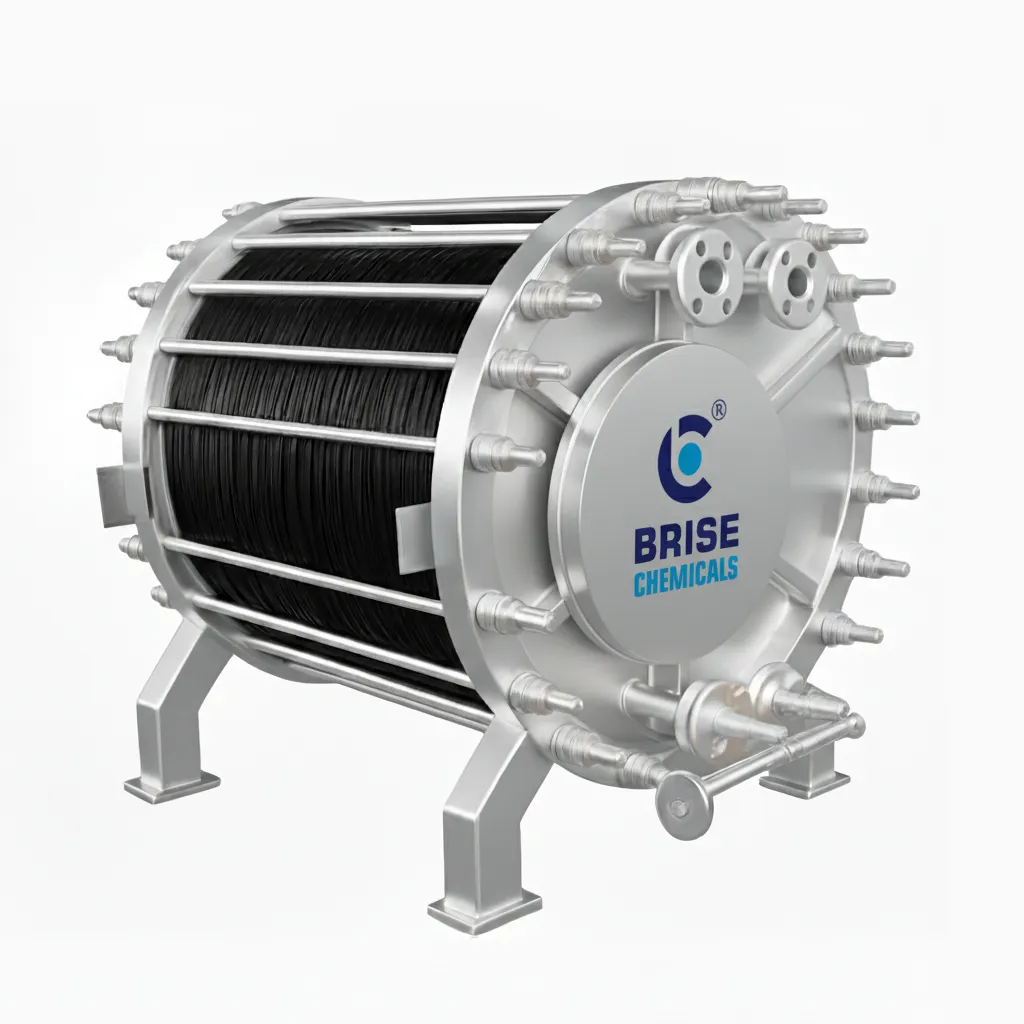
Alkaline Electrolyser
Technical Specification
| Category | Specification |
|---|---|
| Electrolyte | 30% NaOH / KOH |
| Stack Size (Energy Consumption) | 3.8 – 4.4 kWh/Nm³ |
| Operating Temperature | 70 – 90 °C |
| Operating Pressure | 1-30 barg |
| Ambient Temperature | 5 – 35 °C |
| Cell Voltage | 230 – 420 V |
| Current Density | 0.2 – 0.8 A/cm² |
| Stack Current | 100 – 4000 A |
| Cell Active Area | 125 – 20,000 cm² |
| Hydrogen Purity (H₂) | 99.99 – 99.9999% |
| Oxygen Purity (O₂) | 99.99 – 99.9999% |
| Oxygen Limit in H₂ | < 2 ppm v |
| Moisture Content | < 2 ppm v |
Brise Electrolyser Key Features
| Category | In-House Capability Focus | Key Expertise & Functions |
|---|---|---|
| I. Core Technology OEM (Electrolyzer Stack) | Product Design & Manufacturing Mastery |
|
| II. Balance of Plant (BOP) Integration | Process System Engineering & Safety |
|
| III. EPC Execution (Balance of System - BOS) | Project Construction & Field Installation |
|
| IV. Commissioning & O&M | Performance Guarantee & Asset Reliability |
|
Appliction
- Industrial hydrogen production
- Green hydrogen for fuel cells and mobility
- Steel, refinery and chemical industries
- Ammonia and methanol production
- Power generation & renewable energy storage
Process Description
Brise Chemicals offers high-efficiency bipolar alkaline hydrogen electrolyzers that split high-purity De- ionzed water into hydrogen and oxygen using DC power. In our compact bipolar design, hydrogen forms at the cathode and oxygen at the anode, delivering higher efficiency and reduced internal losses. The system operates at 0–30 bar, producing pressurized hydrogen without the need for a separate compressor.
Cathode Reaction:
2 H₂O(l) + 2e⁻ → H₂(g) + 2OH⁻(aq)
Anode Reaction:
2OH⁻(aq) → ½O₂(g) + H₂O(l) + 2e⁻
Overall Reaction:
2H₂O(l) → 2H₂(g) + O₂(g)
The generated oxygen can be released or utilized, while hydrogen can be stored, compressed, or used in various clean- energy applications.

