Brise Chemicals: Pioneering Ultra-Efficient Hydrogen Liquefaction
The transition toward a sustainable global energy landscape heavily relies on hydrogen as a primary storage medium, stepping in to replace traditional hydrocarbon fuels. Research from the World Energy Council highlights that burning a kilogram of hydrogen yields triple the energy output of the same amount of gasoline, while yielding zero harmful emissions—only water. At Brise Chemicals Pvt. Ltd., we are helping to accelerate this transition with an exclusive, patented technology designed to optimize the final, critical step of the clean energy supply chain: creating liquid hydrogen.
The Industry Bottleneck: Inefficiency in Deep Cooling
To make mass transportation and long-term storage practical in the absence of pipelines, hydrogen gas must be drastically chilled to -253°C (20K) to achieve a liquid state. While thermodynamic principles dictate an ideal energy requirement of roughly 3.90 kWh/kg for this phase change, standard industrial applications fall significantly short.
Today’s commercial facilities, typically utilizing Claude and Brayton cycles, routinely burn through 9 to 13 kWh/kg of liquid hydrogen. Operating at modest thermodynamic efficiencies of merely 30% to 35%, these conventional setups expose an urgent industry need for solutions that slash Specific Energy Consumption (SEC) alongside capital and operational expenditures.
Our Breakthrough: The Brise Green Liquefaction Technology
Granted under Patent No. 432769, Brise Chemicals has engineered a highly original, green-certified approach to hydrogen liquefaction. Our proprietary system is defined by its use of a single closed-loop architecture that deploys hydrogen gas itself as the sole refrigerating agent.
By cautiously calibrating mass distribution and feed gas splitting, our technology overcomes the primary barriers of modern cryogenic processing:
Dramatically Lower Power Consumption
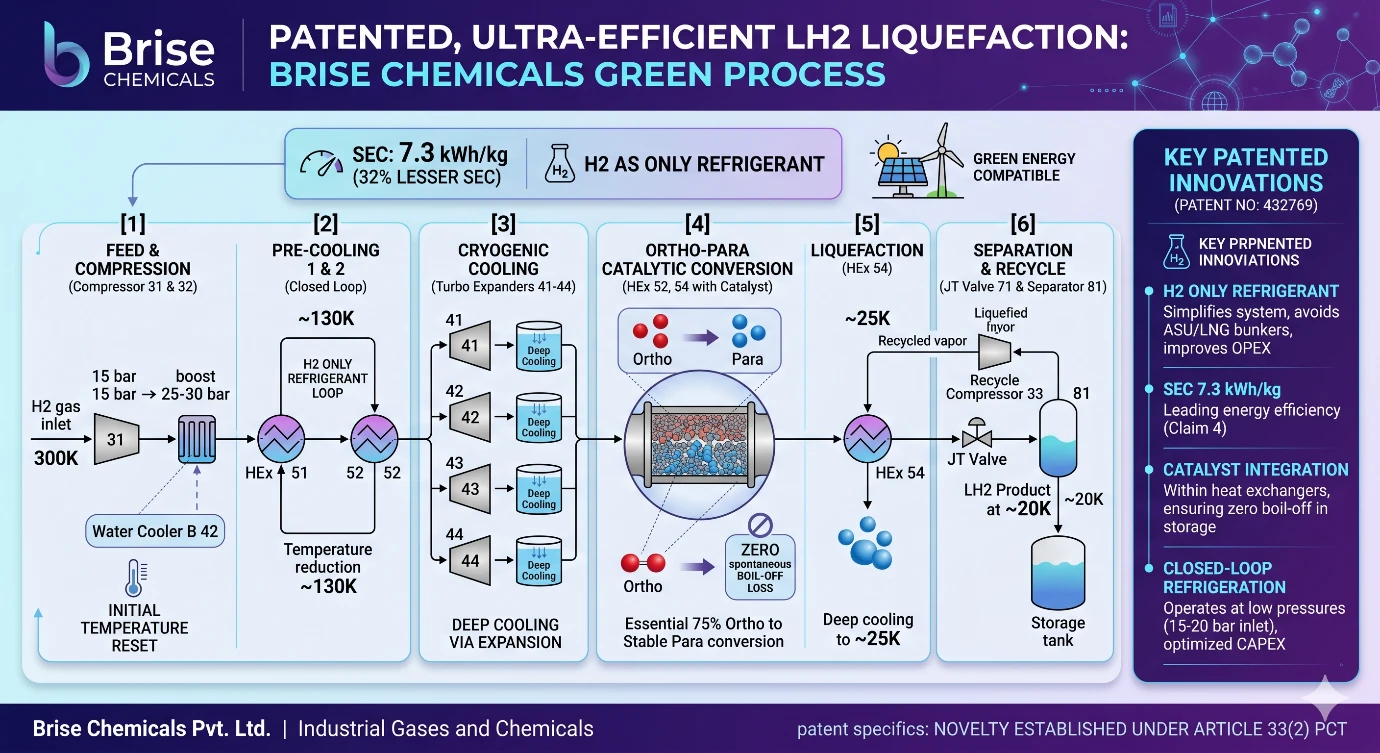
Our system is engineered to operate at a predefined SEC of just 7.3 kWh/kg of liquefied hydrogen. This equates to a 32% reduction in energy usage compared to prevailing industrial benchmarks.
A Truly Green & Independent Footprint
Our method completely removes the necessity for auxiliary, greenhouse-gas-emitting cooling agents. Crucially, the process avoids any pre-cooling with Liquid Nitrogen (LN2), mixed refrigerants, or Liquid Natural Gas (LNG). By eliminating reliance on these external cryogens, project developers bypass the massive capital and geographical constraints of requiring an on-site Air Separation Unit (ASU) or proximity to LNG bunkers. Furthermore, the entire electrolysis and cooling cycle is fully compatible with electricity sourced from renewables like solar and wind.
Cost-Effective Architecture
Because the cooling cycle loops internally using only hydrogen, operators bypass the OPEX tied to purchasing a continuous supply of external refrigerants. We also minimize the total number of heat-radiating compressors required, preventing excess heat discharge into the environment.
Low-Pressure Stability
The cycle efficiently circulates the internal refrigerant gas at modest starting pressures ranging from 15 to 20 bar, drastically reducing mechanical strain on the system.
Integrated Boil-Off Prevention
Raw hydrogen naturally contains a mix of ortho and para isomers (at a 75% to 25% ratio). To prevent product loss through spontaneous evaporation during storage, our custom-built heat exchangers integrate specialized catalysts that guarantee the complete conversion of ortho-hydrogen to para-hydrogen seamlessly during the cooling phase.
Inside the System: Process Overview
Housed within a thermally insulated (adiabatic) canister, our framework leverages a strategic network of turbo-expanders, water coolers, and multi-stream brazed aluminum heat exchangers.
Incoming feed gas is pressurized to 25-30 bar, then meticulously split at an exact 0.12 to 0.88 ratio. These distinct gas pathways are subjected to rigorous pre-cooling and cryogenic cooling phases (dropping to roughly 63K) while the catalytic conversion occurs concurrently within the exchangers.
Finally, the ultra-chilled streams are forced through a Joule-Thomson (JT) valve to reduce pressure. This creates a vapor-liquid mixture that a specialized separator neatly divides, recycling the remaining vapor back into the loop and yielding high-purity liquid product safely into storage tanks.
By fundamentally rethinking how cryogenic cycles interact, Brise Chemicals is proud to deliver a highly scalable, economically viable pathway for global energy independence.