
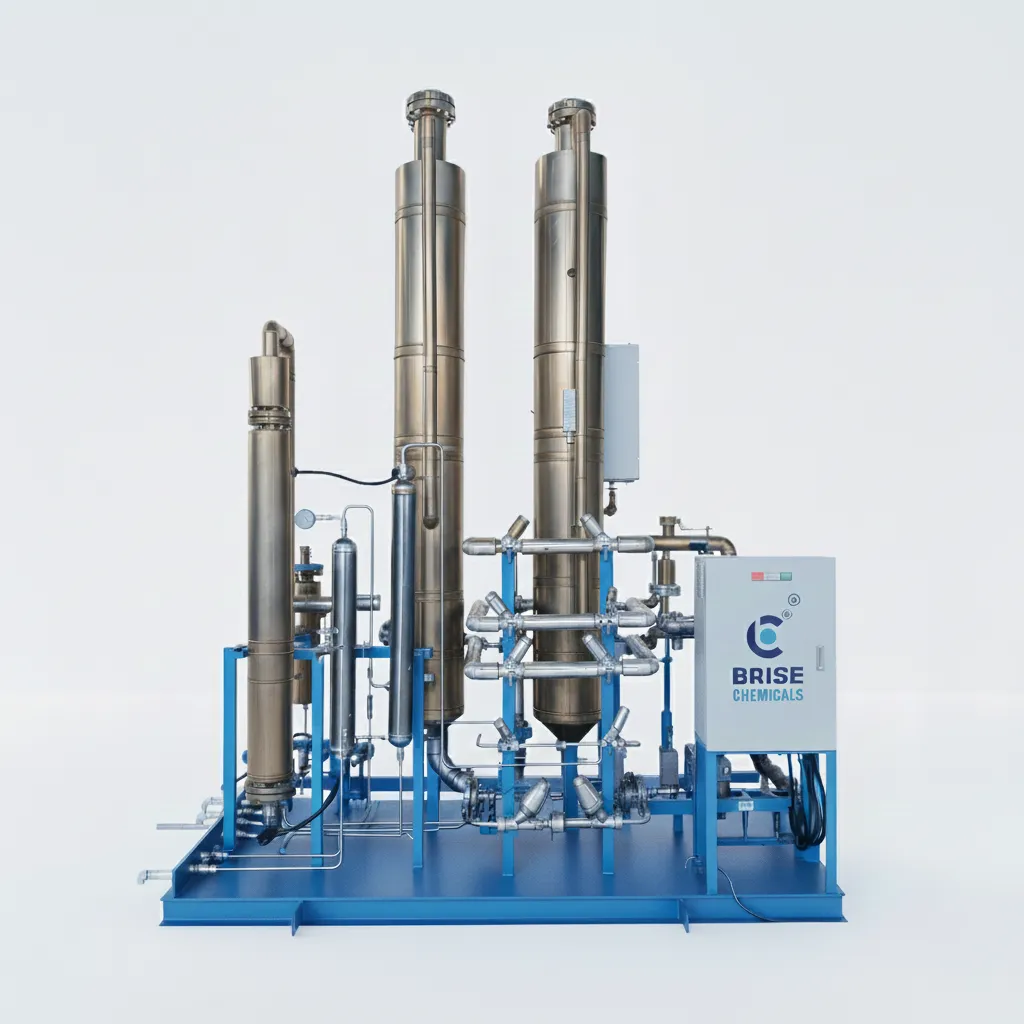
UHP GAS Purification Plant (N2, O2, H2, Ar)
Technical Specification
| Parameter | Specification |
|---|---|
| Target Gases | N₂, O₂, H₂, Ar |
| Inlet Gas Purity | ≥ 99.99% (4N) to 99.999% (5N) |
| Outlet Gas Purity (UHP) | ≥ 99.99999% (7N) to 99.999999% (8N) |
| Purification Technology | Catalytic Bed, Heated Getter, Palladium Membrane (specific to H₂) |
| Key Impurities Removed | H₂O, O₂, CO, CO₂, CH₄, NMHC (Non-Methane Hydrocarbons) |
| Residual Impurities Level | < 1 ppb (parts per billion) typical |
| Operating Pressure | 5 – 15 bar (Standard industrial range) |
| Operating Temperature | Ambient to 400°C (varies depending on the specific getter/catalyst alloy) |
| Pressure Drop (ΔP) | < 0.5 bar |
| Vessel / Piping Material | Electropolished 316L Stainless Steel (to prevent outgassing) |
UHP Gas Purification Process Overview
The process relies on chemical sorption or selective permeation to remove trace impurities (down to parts-per-billion levels) from the gas stream. The typical workflow involves three main stages:
Pre-Filtration
The incoming source gas (N₂, O₂, H₂, or Ar) passes through a highly efficient inlet filter to remove any bulk physical particulates or aerosols before entering the main system.
Core Purification (Chemical or Membrane)
Depending on the specific gas being purified, the stream enters a specialized purification chamber:
- For N₂, O₂, and Ar (Heated Getter / Catalyst Beds): The gas flows through heated stainless-steel vessels packed with specialized chemical “getters” (typically reactive metal alloys like Zirconium-Vanadium) or catalytic materials. As the gas passes through, trace impurities such as moisture (H₂O), oxygen (O₂), carbon oxides (CO, CO₂), and hydrocarbons chemically bind to the getter material and are irreversibly removed from the stream.
- For H₂ (Palladium Membrane Diffusion): Hydrogen is typically purified using a heated Palladium-alloy membrane. Because of hydrogen’s unique atomic structure, only H₂ molecules can dissociate and diffuse through the solid metal matrix of the membrane. All other impurities are physically blocked and vented away in a secondary “bleed” stream.
Final Sub-Micron Filtration
Before exiting the plant, the newly purified UHP gas passes through an ultra-fine metallic particle filter (often rated at 0.003 µm or 3 nanometers). This ensures that absolutely no microscopic dust or particles from the getter/catalyst beds escape into the ultra-clean process line.
Applications of Ultra-High Purity (UHP) Gases
Semiconductor and Microelectronics Manufacturing
Used as carrier gases, purge gases, and reactive environments during wafer fabrication, lithography, and chemical vapor deposition (CVD). Because transistor features are measured in nanometers, even part-per-billion (ppb) impurities can cause microscopic defects that ruin modern microchips.
Analytical Chemistry and Laboratory Instruments
Essential as zero-gases, carrier gases, and calibration gases for highly sensitive equipment like Gas Chromatographs (GC), Mass Spectrometers (MS), and Inductively Coupled Plasma (ICP) instruments. UHP gases prevent background noise and ensure precise baseline readings.
Fiber Optic Production
Used during the preform manufacturing and drawing of optical glass fibers. UHP gases prevent the introduction of impurities that would cause signal attenuation or structural flaws in the delicate glass strands.
Advanced Materials and Nanotechnology
Critical for creating perfectly inert environments during the synthesis of nanomaterials, crystal pulling (such as silicon ingots), and atomic layer deposition (ALD), where trace oxygen or moisture would degrade material properties.
Pharmaceuticals and Biotechnology
Utilized for highly controlled inert blanketing, active pharmaceutical ingredient (API) packaging, and bioreactor purging to prevent oxidation, contamination, or degradation of sensitive medical products.
Flat Panel Display and LED Manufacturing
Essential in the thin-film deposition and etching processes required to manufacture high-definition OLED/LCD screens and light-emitting diodes without microscopic pixel defects.
Aerospace and Defense
Applied in the manufacturing of critical sensors, specialized propulsion system testing, and environmental control systems where component failure is not an option and maximum reliability is required.

